Mastering academic writing often feels like learning a secret language, and when it comes to citing your sources, few styles demand as much precision as Turabian. While its rules might seem daunting at first glance, truly [Understanding Turabian Citation Style] is about embracing a clear, consistent framework for giving credit where it's due and allowing your readers to follow your intellectual journey. Think of it not as a hurdle, but as a robust system designed to bolster the credibility and clarity of your scholarly work.
At a Glance: Your Quick Turabian Toolkit
Before we dive deep, here are the essential takeaways about Turabian:
- Two Main Flavors: Turabian offers two distinct citation systems: Notes and Bibliography (N&B) and Author-Date.
- Chicago's Younger Sibling: It's essentially a student-focused version of Chicago style, designed for dissertations, theses, and papers.
- Notes & Bibliography (N&B): Favored in humanities (history, literature). Uses footnotes or endnotes for in-text citations, plus a comprehensive bibliography at the end. It's flexible.
- Author-Date: Preferred in sciences and social sciences. Uses brief parenthetical citations (Author, Year) in the text, linked to a full reference list.
- Always Check: Your instructor or publisher is the ultimate authority on which style to use.
- Consistency is Key: Whichever style you pick, stick with it meticulously throughout your entire paper.
Why Turabian Matters: More Than Just Rules
You might wonder why such specific rules exist. Turabian, formally known as A Manual for Writers of Research Papers, Theses, and Dissertations by Kate L. Turabian, provides a standardized method for scholarly communication. It ensures:
- Academic Integrity: You accurately credit the ideas and words of others, avoiding plagiarism.
- Verifiability: Your readers can easily locate and verify the sources you used.
- Professionalism: Your paper looks polished and adheres to academic standards, enhancing its credibility.
In essence, Turabian isn't just about commas and italics; it's about transparency and respect for intellectual property, creating a common language for scholarly dialogue.
Decoding the Duo: Notes and Bibliography vs. Author-Date
At its heart, Turabian offers flexibility, primarily through its two distinct citation methods. While the overall formatting of your paper (margins, title page, headings) remains largely consistent, the way you cite sources within the text and list them at the end differs significantly between the Notes and Bibliography (N&B) style and the Author-Date style. Understanding these differences is your first critical step.
Style 1: Notes and Bibliography (N&B) – The Humanities' Choice
The Notes and Bibliography style is a hallmark of the humanities—think history papers, literary analyses, or art history essays. It's a system designed to accommodate extensive commentary and varied source types, offering a rich tapestry of scholarly engagement.
How N&B Works
In this system, you'll use numbered footnotes (at the bottom of the page) or endnotes (at the end of your paper) to cite your sources. These notes correspond to a superscript number placed in your text immediately after the information you're citing.
Crucially, N&B usually requires two types of entries for each source:
- Short Form Notes: These appear in your footnotes/endnotes after the first full citation of a source. They are concise, typically including only the author's last name, a shortened title, and the page number(s).
- Full Bibliography Entry: A comprehensive list of all sources cited and consulted, alphabetized by author's last name, appears at the very end of your paper.
When to Use N&B
- When your instructor specifically requests it.
- When working in humanities fields (history, literature, philosophy, arts).
- When you need to provide more extensive commentary or multiple citations for a single point without cluttering the main text.
N&B In Practice: Footnotes and Bibliography
Let's look at a common example: a book by a single author.
In-Text Citation (Superscript Number):
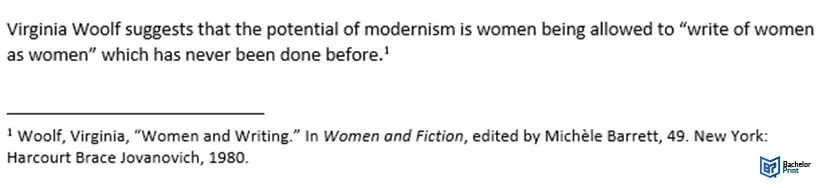
Scholars have long debated the precise impact of the printing press on Renaissance thought.¹
First Footnote Entry (Full Citation):
- Elizabeth L. Eisenstein, The Printing Revolution in Early Modern Europe, 2nd ed. (Cambridge: Cambridge University Press, 2005), 45-47.
Subsequent Footnote Entry (Short Form): - Eisenstein, Printing Revolution, 52.
Bibliography Entry (Full Citation):
Eisenstein, Elizabeth L. The Printing Revolution in Early Modern Europe. 2nd ed. Cambridge: Cambridge University Press, 2005.
Key Point: Notice how the footnote and bibliography entries for the same source have subtle differences in formatting (e.g., author name order, punctuation, use of parentheses for publication details). This meticulous detail is central to Turabian.
The Flexibility of Notes
One of N&B's strengths is its flexibility. You can:
- Combine citations: If you're drawing from multiple sources for one point, you can list them all in a single footnote, separated by semicolons.
- Add commentary: Footnotes can include brief discussions, qualifications, or tangential information that isn't central to your main argument but provides valuable context for your reader.
Style 2: Author-Date – The Sciences' Standard
The Author-Date style is the preferred system in the physical, natural, and social sciences. It offers a more streamlined approach, prioritizing brevity in the main text while directing readers to a comprehensive reference list.
How Author-Date Works
Instead of notes, this style uses brief parenthetical citations within the text. These citations typically include the author's last name and the year of publication, often followed by a page number if you're quoting or referring to a specific passage.
All in-text citations correspond to an entry in a single, alphabetized Reference List (not a bibliography) at the end of your paper. This list provides full bibliographic details for every source you've cited.
When to Use Author-Date
- When your field or instructor requires it (e.g., psychology, sociology, biology, economics).
- When your research prioritizes the recency or specific authorship of a source.
- When a concise, unobtrusive citation style is preferred.
Author-Date In Practice: In-Text Citations and Reference List
Let's revisit our book example using the Author-Date style.
In-Text Citation (Parenthetical):
Research suggests that cognitive biases significantly influence decision-making (Kahneman 2011, 49).
In-Text Citation (Author Mentioned in Sentence):
Kahneman (2011, 49) argues that cognitive biases significantly influence decision-making.
Reference List Entry (Full Citation):
Kahneman, Daniel. 2011. Thinking, Fast and Slow. New York: Farrar, Straus and Giroux.
Key Point: The in-text citation immediately tells the reader who said what and when, making it easy to cross-reference with the full entry in the reference list.
Why Author-Date is Popular in Sciences
The Author-Date system is particularly well-suited for scientific disciplines because:
- Emphasis on Recency: The year of publication is immediately visible in the text, which is often crucial in fast-evolving scientific fields.
- Conciseness: It keeps the main text flow relatively uninterrupted, allowing readers to focus on the content without lengthy footnotes.
- Streamlined Reference List: The direct link between in-text citations and the reference list makes for quick look-ups.
The Fine Print: Essential Formatting for Common Sources
Regardless of whether you choose Notes and Bibliography or Author-Date, Turabian provides meticulous guidelines for formatting specific types of sources. While the exact punctuation and order differ between the two main styles, the information required remains largely consistent.
Here, we'll outline examples for the most common source types. Remember, these are just starting points; the Turabian manual (9th edition) offers hundreds of variations. For the ultimate time-saver, you might consider using a Turabian citation generator to help create accurate citations quickly.
Citing a Book (Single Author)
Notes and Bibliography Style:
- First Footnote:
- Michael Pollan, The Omnivore's Dilemma: A Natural History of Four Meals (New York: Penguin Press, 2006), 99.
- Subsequent Footnote:
- Pollan, Omnivore's Dilemma, 105.
- Bibliography Entry:
Pollan, Michael. The Omnivore's Dilemma: A Natural History of Four Meals. New York: Penguin Press, 2006.
Author-Date Style: - In-Text Citation: (Pollan 2006, 99)
- Reference List Entry:
Pollan, Michael. 2006. The Omnivore's Dilemma: A Natural History of Four Meals. New York: Penguin Press.
Citing a Journal Article (Online)
Notes and Bibliography Style:
- First Footnote:
- Sarah T. Meltzer, "The Rhetoric of Risk: Political Discourse on Genetically Modified Organisms," Environmental Communication 5, no. 1 (February 2011): 88, https://doi.org/10.1080/17524032.2010.536979.
- Subsequent Footnote:
- Meltzer, "Rhetoric of Risk," 92.
- Bibliography Entry:
Meltzer, Sarah T. "The Rhetoric of Risk: Political Discourse on Genetically Modified Organisms." Environmental Communication 5, no. 1 (February 2011): 85–104. https://doi.org/10.1080/17524032.2010.536979.
Author-Date Style: - In-Text Citation: (Meltzer 2011, 88)
- Reference List Entry:
Meltzer, Sarah T. 2011. "The Rhetoric of Risk: Political Discourse on Genetically Modified Organisms." Environmental Communication 5, no. 1 (February): 85–104. https://doi.org/10.1080/17524032.2010.536979.
Citing a Website
Notes and Bibliography Style:
- First Footnote:
- "About Turabian Style," Chicago Manual of Style Online, accessed October 26, 2023, https://www.chicagomanualofstyle.org/turabian/turabian-faqs.html.
- Subsequent Footnote:
- "About Turabian Style."
- Bibliography Entry:
Chicago Manual of Style Online. "About Turabian Style." Accessed October 26, 2023. https://www.chicagomanualofstyle.org/turabian/turabian-faqs.html.
Author-Date Style: - In-Text Citation: (Chicago Manual of Style Online 2023)
If no date is available, use "n.d." for "no date": (Chicago Manual of Style Online n.d.) - Reference List Entry:
Chicago Manual of Style Online. 2023. "About Turabian Style." Accessed October 26. https://www.chicagomanualofstyle.org/turabian/turabian-faqs.html.
Important Note on Websites: Always include an access date for online sources, especially those that might change over time, as per Turabian guidelines.
Beyond the Basics: Paper Formatting and Style Guidelines
Turabian isn't just about citations; it's a comprehensive guide to formatting your entire academic paper. Adhering to these guidelines ensures a professional, readable document.
General Document Formatting
- Margins: Typically 1 inch (2.54 cm) on all sides.
- Font: A readable serif font, usually 10-12 point (e.g., Times New Roman, Garamond).
- Line Spacing: Double-space the main text, with exceptions for block quotes, footnotes/endnotes, bibliography/reference list entries, and table/figure captions, which are often single-spaced.
- Page Numbers: Usually placed in the upper right corner, starting with page 1 on the first page of text (the title page and copyright page, if any, are often unnumbered but counted).
Headings
Turabian offers a clear hierarchy for headings, allowing you to structure your paper logically. You can use up to five levels, each with distinct formatting:
- Level 1 (Main Headings): Centered, boldface, title case.
- Level 2 (Subheadings): Centered, regular type, title case.
- Level 3 (Sub-subheadings): Flush left, boldface, title case.
- Level 4 (Further Subdivision): Flush left, regular type, title case.
- Level 5 (Even Further): Run in at the beginning of a paragraph, boldface, sentence case, ending with a period.
Always use headings consistently and logically to guide your reader through your argument.
Title Page
A Turabian title page is typically unnumbered but counted as page i. It includes:
- The title of your paper (centered, about one-third down the page, in title case).
- Your name.
- The course name and number.
- The date.
- Your institution's name (optional, check with your instructor).
Common Questions and Pitfalls to Avoid
Even seasoned writers occasionally stumble with citation styles. Here are some common questions and traps to steer clear of:
"Which Turabian style should I use?"
The golden rule: Always ask your instructor or editor first. If they don't specify, consider your discipline: humanities typically lean towards Notes and Bibliography, while sciences prefer Author-Date. When in doubt, default to N&B as it's the more comprehensive and flexible option often associated with the "classic" Turabian.
"What if I can't find all the information for a source?"
Do your best. Turabian advises including all available information and indicating when elements are missing (e.g., "n.d." for no date, "n.p." for no publisher or place of publication). Don't invent details.
"When do I need to cite?"
Cite whenever you:
- Directly quote someone else's words.
- Paraphrase someone else's ideas.
- Summarize someone else's work.
- Use data, statistics, or unique information that isn't common knowledge.
- Refer to specific theories or arguments by others.
When in doubt, cite. Over-citation is far better than accidental plagiarism.
Pitfall 1: Inconsistent Formatting
The biggest Turabian sin is inconsistency. If you use "p." for page in one footnote, don't use "pg." in the next. If you use an en dash for page ranges, don't switch to a hyphen. Pick a format and stick to it religiously. This is where a reliable Turabian citation generator can be invaluable, maintaining consistency across your entire paper.
Pitfall 2: Confusing Footnotes with Bibliography Entries (N&B)
Remember, footnotes are generally single-spaced with a hanging indent (though often the word processor handles this automatically), and the author's first name comes first. Bibliography entries are single-spaced within each entry but double-spaced between entries, with a hanging indent, and the author's last name comes first. They are distinct.
Pitfall 3: Not Using Page Numbers for Direct Quotes
When directly quoting or referring to a specific passage, a page number (or range) is almost always required, even in Author-Date style. Without it, your reader can't easily find the exact text you're referencing.
Pitfall 4: Forgetting the Bibliography/Reference List
This might sound obvious, but under pressure, it's easy to overlook. Always include the comprehensive list of sources at the end of your paper. It's not optional.
Pitfall 5: Mixing Styles
Never mix Notes and Bibliography with Author-Date within the same paper. Choose one and commit. Your instructor will not be pleased with a hybrid approach.
Beyond the Manual: The Art of Academic Writing
While Turabian provides the rules, the true mastery of academic writing lies in how you integrate those citations into your own scholarly voice. It's not just about placing a footnote or a parenthetical reference; it's about using sources to build your argument, provide evidence, and engage in a larger academic conversation.
Think of your sources as supporting cast members in your intellectual play. They provide the backstory, the expert opinions, and the data, but your voice, your argument, and your analysis are the stars.
Developing Your Scholarly Voice
- Introduce sources smoothly: Don't just drop a quote. Introduce the author or idea, explain its relevance, and then provide the citation.
- Analyze, don't just summarize: After presenting evidence from a source, explain what it means for your argument.
- Vary your citation methods: Sometimes quoting is best, other times paraphrasing. Learn to choose the most effective way to integrate source material.
- Proofread relentlessly: After all the hard work of research and writing, minor citation errors can detract from your credibility. Always proofread your footnotes/endnotes and bibliography/reference list carefully.
Your Next Steps: Embracing the Turabian Journey
Understanding Turabian citation style is a cornerstone of academic success. It equips you with the tools to write responsibly, clearly, and persuasively. While it may seem like a detailed maze initially, with practice, it becomes second nature.
Your best resources are:
- Your Instructor: They have the final say on specific requirements.
- The Turabian Manual: The 9th edition is the authoritative source. Chapters 16 & 17 cover Notes and Bibliography, while 18 & 19 detail Author-Date.
- University Writing Centers: Often provide excellent resources and one-on-one help.
- Online Tools: Resources like a Turabian citation generator can streamline the process and minimize errors, especially for common source types.
Don't let the rules intimidate you. View Turabian as a guide that helps you structure your thoughts and present your research with clarity and integrity. The more you use it, the more fluid and natural the process will become, allowing you to focus on what truly matters: your ideas and your contribution to scholarship. Embrace the journey, and watch your academic writing skills flourish.