Navigating academic citations can feel like deciphering an ancient script, but mastering Turabian Style, particularly its Notes and Bibliography system, is your ticket to clear, credible, and universally understood scholarly communication. This guide cuts through the jargon, offering a direct, human-first approach to confidently handling footnotes, endnotes, and bibliographies, ensuring your research shines with academic integrity.
At a Glance: Your Turabian Toolkit
- Turabian is about clarity: It prioritizes clear, consistent attribution.
- Notes (footnotes or endnotes) are for in-text citations: They provide immediate source details.
- Bibliography is your master list: It offers full publication information for every source, alphabetized.
- "Full" vs. "Shortened" Notes: Know when to use each for efficiency.
- Source Type Matters: Books, articles, websites, and more each have specific formatting nuances.
- Consistency is Key: Once you pick a style, stick with it throughout your work.
- Tools can help: A good Turabian bibliography generator can streamline the process, but always double-check.
Unpacking Turabian: Your Guide to Credible Writing
You’ve invested countless hours in research, crafting arguments, and polishing your prose. Now comes the crucial step of attributing your sources, a process that, while seemingly mechanical, is fundamental to your credibility. Turabian Style, officially known as A Manual for Writers of Research Papers, Theses, and Dissertations by Kate L. Turabian, is a widely adopted standard, especially in the humanities, social sciences, and arts. It’s essentially a simplified version of the Chicago Manual of Style, tailored specifically for students and researchers.
Our focus here is on Turabian’s Notes-Bibliography system—a dual approach that uses numbered notes (either footnotes at the bottom of the page or endnotes at the end of the chapter/paper) for in-text citations, coupled with a comprehensive bibliography at the end of your work. This system is perfect for disciplines where detailed discussion of sources is common, allowing for robust academic engagement without interrupting the flow of your argument.
The Notes System: Your In-Text Compass
Notes are your first line of defense against plagiarism and your primary way to guide readers directly to the specific information you're referencing. Think of them as signposts within your text.
When to Use Notes
Every time you quote, paraphrase, summarize, or refer to a specific idea or piece of information from a source, you need a note. A superscript number appears in your text immediately after the cited material, linking directly to the corresponding note.
Full Notes: The First Impression
Your first time citing a particular source, you'll use a "full note." This note provides complete publication information, giving your reader everything they need to find that exact source quickly.
Key Components of a Full Note:
- Author(s) Name(s): First name then last name.
- Title of Source: Italicized for books/journals, in quotation marks for articles/chapters.
- Publication Details: City, publisher, year for books; journal title, volume, issue, date for articles.
- Specific Page Number(s): Where the information can be found.
General Format:
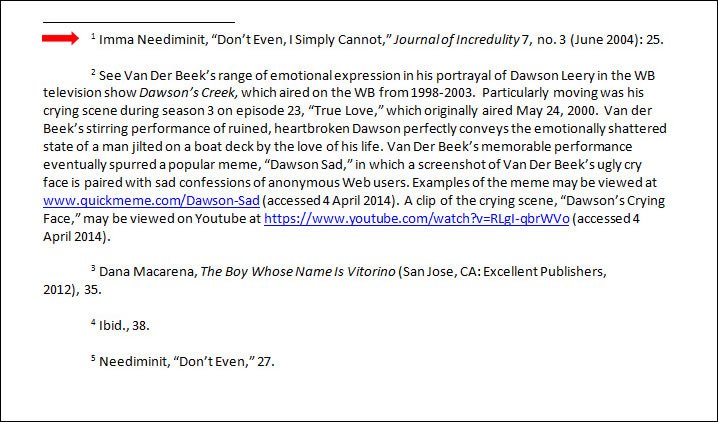
- Author First Name Last Name, Title of Book (City: Publisher, Year), page number.
- Author First Name Last Name, "Title of Article," Journal Title Volume, no. Issue (Date): page number.
Shortened Notes: Beyond the First Encounter
After you've introduced a source with a full note, subsequent citations to that same source become much leaner. These "shortened notes" are a staple of Turabian, designed for efficiency.
Key Components of a Shortened Note:
- Author Last Name: Only the last name.
- Shortened Title: A key word or phrase from the title, enough to distinguish it from other sources.
- Specific Page Number(s): Essential for direct reference.
General Format:
- Author Last Name, Shortened Title, page number.
- Author Last Name, "Shortened Article Title," page number.
Example Scenario:
Text: "Some scholars argue for a radical rethinking of economic models, suggesting that current frameworks are unsustainable without significant ethical considerations.¹ Others contend that minor adjustments are sufficient.²"
Full Note (First citation of Smith): - John Smith, The Ethics of Economic Practice (New York: Academic Press, 2020), 45.
Shortened Note (Subsequent citation of Smith): - Smith, Ethics, 112.
Important Note on "Ibid.": Turabian allows for "Ibid." (Latin for "in the same place") if a note refers to the immediately preceding note's source and page number. If it's the same source but a different page, you’d use "Ibid., page number." However, using shortened titles is generally more robust and less prone to error if you later insert or delete notes. Many instructors prefer you use shortened notes even for consecutive citations.
Footnotes vs. Endnotes: Choosing Your Placement
The primary difference between footnotes and endnotes is simply where they appear:
- Footnotes: Located at the bottom of the page where the corresponding text reference appears. They offer immediate access to source information, making them ideal for readers who want to verify sources as they read.
- Endnotes: Collected at the end of a chapter or the entire paper, before the bibliography. They can make your text pages look cleaner by avoiding the interruptions of footnotes, but they require readers to flip to the end to check sources.
Your choice largely depends on your instructor's preference or the conventions of your discipline. Most word processors handle the automatic numbering and placement of both footnotes and endnotes with ease. Just pick one and stick with it.
Crafting Your Bibliography: The Master List
While notes provide in-the-moment details, your bibliography is the comprehensive roll call of every source you consulted, whether you explicitly cited it or not. It provides a complete, alphabetized list for your reader, allowing them to explore your research further.
The Purpose of a Bibliography
The bibliography serves several critical functions:
- Comprehensive Listing: It lists all sources used, even those you might have only consulted for background.
- Full Details: Unlike notes, bibliography entries provide all the necessary publication information, including the full page range for articles or chapters within edited books.
- Alphabetical Order: Entries are typically listed alphabetically by the author's last name (or by title if no author is listed).
- Discovery Tool: It offers readers a roadmap to delve deeper into your research topic.
Key Differences from Notes
Remember, notes and bibliography entries, though related, have distinct formatting rules:
- Author Order: In notes, author names are "First Name Last Name." In the bibliography, the first author's name is "Last Name, First Name" for alphabetical sorting, with subsequent authors listed "First Name Last Name."
- Punctuation: Notes primarily use commas to separate elements. Bibliography entries use periods.
- Parentheses: Publication details for books are enclosed in parentheses in notes but not in bibliography entries.
- Page Numbers: Notes include specific page numbers for the cited material. Bibliography entries for articles or chapters include the full page range of the entire work, but not for whole books or websites.
Source-Specific Citations: A Practical Guide
Now, let's dive into the specifics for common source types. This is where Turabian truly demonstrates its flexibility and precision.
Books: The Foundational Source
Books are the backbone of many research projects. Their citation is straightforward, with minor variations for edited or translated works.
Full Book
Note:
- Author First Name Last Name, Title of Book (City: Publisher, Year), page number.
Example: 1. Jane Doe, The Art of Journalistic Inquiry (Chicago: University of Chicago Press, 2021), 78.
Bibliography:
Author Last Name, First Name. Title of Book. City: Publisher, Year.
Example: Doe, Jane. The Art of Journalistic Inquiry. Chicago: University of Chicago Press, 2021.
Chapter or Part of an Edited Book
When citing a specific chapter or essay within a larger edited collection, you prioritize the chapter details in the note, and include the chapter's page range in the bibliography.
Note (citing a chapter):
- Chapter Author First Name Last Name, "Title of Chapter," in Title of Edited Book, ed. Editor First Name Last Name (City: Publisher, Year), page number.
Example: 1. Michael Jones, "Digital Ethics in the Modern Age," in Essays on Media Responsibility, ed. Sarah Lee (London: Routledge, 2019), 115.
Bibliography (for the chapter):
Chapter Author Last Name, First Name. "Title of Chapter." In Title of Edited Book, edited by Editor First Name Last Name, chapter page range. City: Publisher, Year.
Example: Jones, Michael. "Digital Ethics in the Modern Age." In Essays on Media Responsibility, edited by Sarah Lee, 101–120. London: Routledge, 2019.
Bibliography (for the entire edited book):
Editor Last Name, First Name, ed. Title of Edited Book. City: Publisher, Year.
Example: Lee, Sarah, ed. Essays on Media Responsibility. London: Routledge, 2019.
Translated Book
Include the translator's name, prefaced by "trans." or "Translated by."
Note:
- Author First Name Last Name, Title of Book, trans. Translator First Name Last Name (City: Publisher, Year), page number.
Example: 1. Haruki Murakami, Kafka on the Shore, trans. Philip Gabriel (New York: Knopf, 2005), 32.
Bibliography:
Author Last Name, First Name. Title of Book. Translated by Translator First Name Last Name. City: Publisher, Year.
Example: Murakami, Haruki. Kafka on the Shore. Translated by Philip Gabriel. New York: Knopf, 2005.
E-book
For e-books, provide a URL or database name if accessed online. If it's a specific e-reader format (like Kindle), note that. If page numbers are absent, cite by section title or chapter number, or try to find a print version for fixed pagination.
Note (online with URL):
- Author First Name Last Name, Title of E-book (City: Publisher, Year), page number, URL.
Example: 1. Mark Twain, The Adventures of Tom Sawyer (New York: Charles L. Webster and Company, 1884), 75, https://www.gutenberg.org/files/74/74-h/74-h.htm.
Note (Kindle edition): - Author First Name Last Name, Title of E-book (City: Publisher, Year), Kindle.
Example: 1. Laura Hillenbrand, Seabiscuit: An American Legend (New York: Random House, 2001), chap. 3, Kindle.
Bibliography (online):
Author Last Name, First Name. Title of E-book. City: Publisher, Year. URL.
Example: Twain, Mark. The Adventures of Tom Sawyer. New York: Charles L. Webster and Company, 1884. https://www.gutenberg.org/files/74/74-h/74-h.htm.
Bibliography (Kindle):
Author Last Name, First Name. Title of E-book. City: Publisher, Year. Kindle.
Example: Hillenbrand, Laura. Seabiscuit: An American Legend. New York: Random House, 2001. Kindle.
Thesis or Dissertation
These academic works are often available through university repositories or databases.
Note:
- Author First Name Last Name, "Title of Thesis/Dissertation" (Type of degree, University, Year), database name or URL.
Example: 1. Emily White, "The Rhetoric of Climate Change Denial" (PhD diss., University of California, Berkeley, 2018), ProQuest Dissertations & Theses Global.
Bibliography:
Author Last Name, First Name. "Title of Thesis/Dissertation." Type of degree, University, Year. Database name or URL.
Example: White, Emily. "The Rhetoric of Climate Change Denial." PhD diss., University of California, Berkeley, 2018. ProQuest Dissertations & Theses Global.
Journal Articles: Scholarly Deep Dives
Journal articles are crucial for current research. Pay attention to volume, issue, and page ranges.
Note:
- Author First Name Last Name, "Title of Article," Journal Title Volume, no. Issue (Date): page number.
Example: 1. David Chen, "The Impact of Social Media on Political Discourse," Political Science Quarterly 135, no. 2 (Summer 2020): 215.
Bibliography:
Author Last Name, First Name. "Title of Article." Journal Title Volume, no. Issue (Date): full page range.
Example: Chen, David. "The Impact of Social Media on Political Discourse." Political Science Quarterly 135, no. 2 (Summer 2020): 201–230.
Online Articles with DOI or URL:
A DOI (Digital Object Identifier) is a permanent link, always preferred over a general URL.
Note (with DOI): - Author First Name Last Name, "Title of Article," Journal Title Volume, no. Issue (Date): page number, doi:DOI number.
Example: 1. Maria Garcia, "Urban Planning and Green Spaces," Environmental Studies Journal 42, no. 3 (March 2019): 310, doi:10.1086/678910.
Bibliography (with DOI):
Author Last Name, First Name. "Title of Article." Journal Title Volume, no. Issue (Date): full page range. doi:DOI number.
Example: Garcia, Maria. "Urban Planning and Green Spaces." Environmental Studies Journal 42, no. 3 (March 2019): 300–320. doi:10.1086/678910.
Four or More Authors:
For notes, list the first author followed by "et al." (Latin for "and others"). For the bibliography, list up to ten authors. If there are more than ten, list the first seven followed by "et al."
Note (four or more authors): - First Author First Name Last Name et al., "Title of Article," Journal Title Volume, no. Issue (Date): page number.
Example: 1. Sarah Ahmed et al., "The Neuroscience of Decision-Making," Cognitive Psychology Review 12, no. 1 (January 2021): 55.
Bibliography (four authors):
Ahmed, Sarah, John Brown, Emily Carter, and David Evans. "The Neuroscience of Decision-Making." Cognitive Psychology Review 12, no. 1 (January 2021): 40–60.
News or Magazine Articles: Current Events
These sources often lack stable page numbers in their online versions.
Note:
- Author First Name Last Name, "Title of Article," News/Magazine Title, Date of publication, URL.
Example: 1. Olivia Kim, "The Future of Remote Work," The New York Times, October 26, 2022, https://www.nytimes.com/2022/10/26/business/remote-work-future.html.
Bibliography:
Author Last Name, First Name. "Title of Article." News/Magazine Title, Date of publication. URL.
Example: Kim, Olivia. "The Future of Remote Work." The New York Times, October 26, 2022. https://www.nytimes.com/2022/10/26/business/remote-work-future.html.
- Page numbers: If a print version has page numbers, include them in the note but omit them from the bibliography entry.
- Reader comments: Cite these in text or a note if necessary, but generally exclude them from the bibliography.
Book Review: Analyzing Literature
When citing a review of a book, ensure you clearly identify both the reviewer and the work being reviewed.
Note:
- Reviewer First Name Last Name, "Title of Review," review of Title of Reviewed Book, by Reviewed Author First Name Last Name, Journal/Magazine Title Volume, no. Issue (Date): page number.
Example: 1. Robert Miller, "A Powerful Narrative," review of The Lost Generation, by Anne Thompson, Literary Review 45, no. 2 (Spring 2021): 89.
Bibliography:
Reviewer Last Name, First Name. "Title of Review." Review of Title of Reviewed Book, by Reviewed Author First Name Last Name. Journal/Magazine Title Volume, no. Issue (Date): full page range.
Example: Miller, Robert. "A Powerful Narrative." Review of The Lost Generation, by Anne Thompson. Literary Review 45, no. 2 (Spring 2021): 88–92.
Website Content: The Digital Frontier
Websites are dynamic, so an access date is crucial if no publication, posting, or revision date is available.
Note:
- Author First Name Last Name (if available), "Title of Webpage," Organization Name, last modified Month Day, Year or accessed Month Day, Year, URL.
Example: 1. "About Us," The National Archives, accessed January 15, 2023, https://www.archives.gov/about.
Bibliography:
Author Last Name, First Name (if available). "Title of Webpage." Organization Name. Last modified Month Day, Year or accessed Month Day, Year. URL.
Example: The National Archives. "About Us." Accessed January 15, 2023. https://www.archives.gov/about.
Audiovisual Content: Beyond Text
This category covers interviews, videos, podcasts, and more. Adapt the format to include relevant creators, type, date, and duration.
Note (e.g., Interview):
- Interviewee First Name Last Name (or Creator), "Title/Description of Content," Type, Name of Website/Platform, Month Day, Year, duration, URL.
Example: 1. Brené Brown, "The Power of Vulnerability," TED Talk, filmed June 2010 at TEDxHouston, posted June 2010, video, 20:49, https://www.ted.com/talks/brene_brown_the_power_of_vulnerability.
Bibliography (e.g., Interview):
Interviewee Last Name, First Name (or Creator). "Title/Description of Content." Type. Name of Website/Platform. Month Day, Year. Duration. URL.
Example: Brown, Brené. "The Power of Vulnerability." TED Talk. Filmed June 2010 at TEDxHouston. Posted June 2010. Video, 20:49. https://www.ted.com/talks/brene_brown_the_power_of_vulnerability.
Social Media Content: Ephemeral Information
Social media posts are often cited directly in your text or in a note, and rarely appear in the bibliography due to their transient nature. If you must cite, use the first 160 characters of the post as the "title."
Note:
- Author/User Name, "First 160 characters of post..." (Platform, Month Day, Year, Time).
Example: 1. NASA, "A new era of exploration begins! 🚀 The Artemis I mission is underway..." (Twitter, November 16, 2022, 1:47 a.m. EST).
Personal Communication: Direct Exchange
Interviews, emails, letters, and direct messages are typically cited only in your text or in a note. They are rarely included in a bibliography because they are not retrievable by others.
Note:
- Interviewee First Name Last Name, interview by Author First Name Last Name, Month Day, Year.
Example: 1. Dr. Evelyn Reed, interview by author, March 10, 2023.
Mastering Turabian: Beyond the Rules
Understanding the specific formats is a significant step, but true mastery comes from internalizing the principles behind Turabian.
Consistency is Your Best Friend
The cardinal rule of citation is consistency. Once you've chosen between footnotes and endnotes, or a specific way to handle a tricky online source, stick with it throughout your entire work. Inconsistency signals sloppiness and undermines your authority.
The "When in Doubt" Rule
When faced with a source that doesn't neatly fit into a category, or if you're unsure about a detail:
- Prioritize clarity and retrievability: Provide enough information for your reader to find the source themselves.
- Consult the manual: The official Turabian Manual is the definitive guide. If you don't own one, university libraries usually have copies, or online guides often reference its core rules.
- Ask your instructor: They are the final authority for your specific assignment.
Leveraging Technology
While understanding the mechanics is vital, you don't have to build every citation by hand. Tools like dedicated citation managers or a Turabian bibliography generator can save immense time and reduce errors. These tools allow you to input source information and then generate the correct note and bibliography entries automatically. However, always treat these as aids, not replacements for your own critical review. A quick manual check of the generated citation against the rules you've learned here can prevent common mistakes.
Avoiding Common Pitfalls
- Incomplete Information: Missing a publication city, page range, or access date can make a source unusable for your reader.
- Mixing Styles: Do not accidentally use APA or MLA elements within your Turabian work. Each system has its own logic.
- Over-shortening: Shortened notes are great, but ensure there’s enough info (author, distinctive title) to clearly identify the source. If you have two different sources by the same author, you’ll need to include a shortened title in your subsequent notes for both.
- Forgetting to Cite: Every idea that isn't original to you needs attribution. This includes paraphrases and summaries, not just direct quotes.
Your Next Steps: Building Confidence
Mastering Turabian is a skill that develops with practice. Don't aim for perfection on your first try. Instead, focus on understanding the underlying logic: notes guide to specific points, and the bibliography lists all sources comprehensively.
Start by meticulously formatting your sources as you research, rather than waiting until the end. This proactive approach will save you countless headaches. Review your citations carefully, asking yourself: "Could someone else easily find this exact piece of information using my notes and bibliography?"
By embracing Turabian, you're not just following rules; you're joining a scholarly conversation with clarity, precision, and unwavering academic integrity. Now go forth and cite with confidence!